5 Ways UNICEF Is Supporting Sudan's Children
Despite many challenges on the ground, UNICEF and partners continue to deliver lifesaving assistance to children caught in Sudan's brutal civil conflict and related crises. Here are five examples of impact.
Donate today. Your tax-deductible contribution can make a difference.
1. Reaching children with severe acute malnutrition with ready-to-use therapeutic food
Across Sudan, hunger and extreme food insecurity have been pushing children and families to the brink — including in places that have been impossible for humanitarian aid workers to reach.
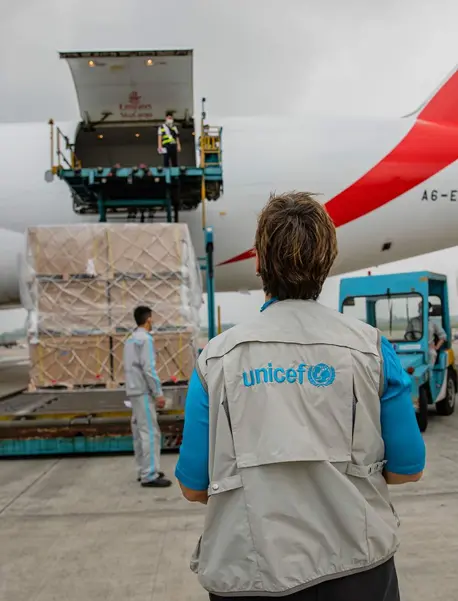
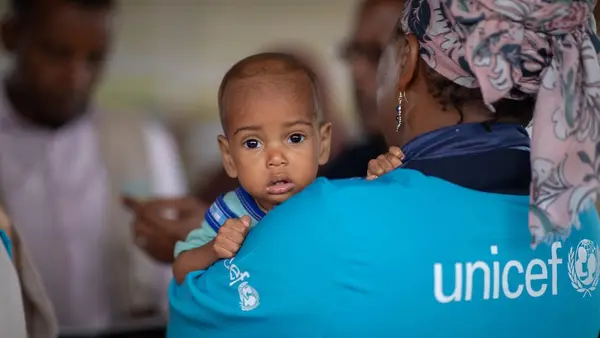
A few weeks ago, after many months without access, UNICEF and partners were finally able to reach those in need in South Kordofan state, where more than 63,000 children are acutely malnourished, including over 10,000 with severe acute malnutrition — the deadliest form. The convoy brought essential medicines and 6,300 cartons of ready-to-use therapeutic food (RUTF) – a nutrient-rich peanut paste that is highly effective for treating severely malnourished children.
With supplies newly available, mothers and caregivers queued patiently at the nutrition clinic at Kadugli hospital, where children were screened using mid-upper arm circumference (MUAC) tapes, weighed and enrolled in treatment on the spot.
Zahra’s 3-year-old daughter, Tatir, was among them, her arm tiny as the health worker measured it. As she tasted her first bite of RUTF, her face brightened.
For Zahra, taking home the sachets of RUTF was a relief she had been waiting for over many months. “At least now my children have a chance,” she said.
Learn more about what UNICEF is doing in Sudan for children in need

2. Supporting frontline health workers to keep services going
With Sudan's health system on the brink of collapse, more than 70 percent of hospitals in conflict-affected areas are non-operational. For relatively safer areas like Kassala, facilities are overwhelmed and running on minimal resources, with staff working without pay.
UNICEF is supporting frontline health workers — midwives, nurses and community health workers — to ensure they can keep vaccinating children and helping pregnant women give birth safely.

3. Providing safe spaces where children can begin to heal from the traumas of war
Makannas — "my spaces" in Arabic — that UNICEF and partners have established all across Sudan are helping children displaced by violence find hope, resilience and a way forward.
In these safe spaces, children are able to learn and play with other kids. Many are also drawing, a way for them to express emotions that may be too painful to put into words. Trained facilitators provide guidance and psychosocial support.
With paper, pencils and colors provided by UNICEF, 10-year-old Khalid drew tanks filled with soldiers and blood when he first arrived at the makanna in Atbara, says Menad, the social worker who leads the art sessions. Lately, though, Khalid has been drawing other things, including a house with his family, reunited, inside — his dream for the future.
"Seeing him draw flowers and hearts is great progress,” Menad says.
Learn more about UNICEF's child-friendly spaces

4. Making sure out-of-school children can continue learning
Support for Sudan's children extends to those who have fled across borders.
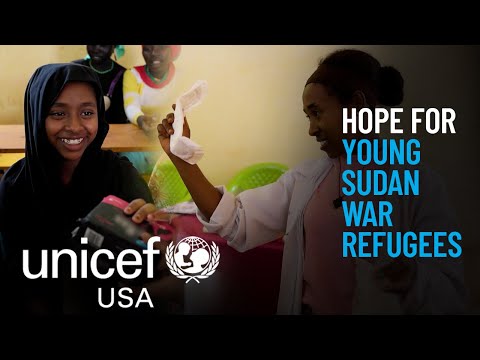
Rahaf, 15, is staying at the Ura refugee camp in Ethiopia's Benishangul-Gumuz region, where she has been able to resume her education. As a member of the gender club, she is also learning about mental health and menstrual health and hygiene.
"I am talking, laughing and learning," Rahaf says. "I am much better than before."
Watch the video:
5. Offering skills training so adolescents can start earning
Some 500 out-of-school adolescents have participated in UNICEF's Learning to Earning Training program, a five-day training in social entrepreneurship, vocational skills and life skills.
Instruction combines theory with hands-on practice. Beyond technical skills, participants learn creativity, confidence, teamwork, self-respect and time management — all critical tools to help them rebuild their lives after years of disrupted routines. The training also provides a sense of community and creates an opportunity to form new friendships and support networks.
“We learned how to work as a team, keep time and respect ourselves and others,” says Fatima, a participant who chose to learn soap making together with her friend Saba. They are both helping to support their families by making and selling liquid soap, while dreaming of returning to school someday.
Learn more about UNICEF-supported life skills and vocational training programs for young people

Help UNICEF deliver direct relief to children in emergencies
Right now, the lives of the most vulnerable children hang in the balance as conflicts and crises jeopardize the care and protection that they deserve. Dependable, uninterrupted and effective foreign aid is critical to the well-being of millions of children. Please contact your members of Congress and urge them to support ongoing U.S. investments in foreign assistance.
HOW TO HELP
There are many ways to make a difference
War, famine, poverty, natural disasters — threats to the world's children keep coming. But UNICEF won't stop working to keep children healthy and safe.
UNICEF works in over 190 countries and territories — more places than any other children's organization. UNICEF has the world's largest humanitarian warehouse and, when disaster strikes, can get supplies almost anywhere within 72 hours. Constantly innovating, always advocating for a better world for children, UNICEF works to ensure that every child can grow up healthy, educated, protected and respected.
Would you like to help give all children the opportunity to reach their full potential? There are many ways to get involved.