UNICEF Support for Children with Disabilities
Children with disabilities face higher risks of exclusion. UNICEF expands inclusive education, assistive technology and community programs to help every child thrive.
Updated July 9, 2026
Challenges children with disabilities face worldwide
An estimated 240 million children around the world have a disability. These children often face multiple challenges in realizing their human rights.
Compared to their peers, children with disabilities are:
- 49 percent more likely to have never attended school at all
- 16 percent less likely to read or be read to at home
- more likely to be affected by hunger and malnourishment — with a 34 percent higher likelihood of stunting and 25 percent higher likelihood of severe acute malnutrition
- 51 percent more likely to feel unhappy
- 49 percent more likely to feel discriminated against
- 32 percent more likely to be subjected to violence through severe corporal punishment
In some low-income countries, as few as 3 percent of children with disabilities have access to wheelchairs, hearing aids, glasses and other assistive technologies they need to fully and equally participate in society.
UNICEF believes that all children, including children with disabilities, have the right to reach their full potential.
UNICEF’s commitment to children with disabilities
Guided by the Sustainable Development Goals (SDGs) and aligned with the Convention on the Rights of the Child (CRC), the Convention on the Rights of Persons with Disabilities (CRPD) and its Disability Inclusion Policy and Strategy, UNICEF includes children with disabilities in all facets of its programming.
The goal: to ensure that every child has the support they need to be healthy, educated, respected and protected.
UNICEF disability-inclusive development and humanitarian programs reached 6.5 million children across more than 140 countries in 2025, up from 4.5 million in 2022.
Related: How UNICEF Fights to Protect the Rights of Children with Disabilities
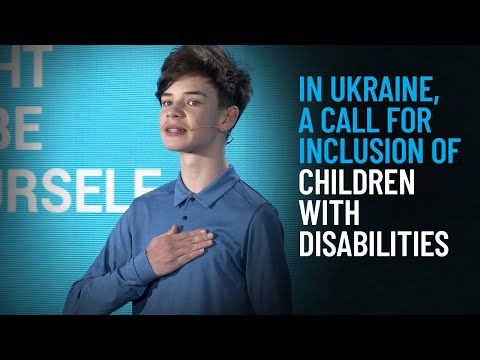
Removing barriers through inclusive services and assistive technology
Working with governments and other partners, UNICEF implements inclusive programs and services that promote the participation of children with disabilities in society.
This work centers around the following cross-sectoral strategic priorities:
- preventing stigma, discrimination, neglect and violence against all children, including children with disabilities
- improving disability-inclusive infrastructure, services, programs and coordinated platforms
- promoting access to comprehensive community care and support services
- widening access to assistive technology and related services
- implementing disability-inclusive action in humanitarian emergencies and fragile contexts
- ensuring the full and meaningful participation of persons with disabilities
Expanding programs for children with disabilities
By integrating supplies into regular programs through market-shaping and procurement mechanisms, UNICEF has rapidly scaled up provision of assistive devices and inclusive products.
In 2025, 933,594 children across 92 countries received assistive technology and inclusive products through UNICEF supported programs — more than four times the 223,244 reached in 2022.
Under the 2026–2029 Strategic Plan, UNICEF aims to screen 90 million children and connect those who need it with inclusive support and assistive technologies such as glasses, hearing aids, wheelchairs and other mobility aids such as crutches or prosthetics.
Related: UNICEF Supports Inclusive Learning for Children With Disabilities
The economic and social costs of excluding children with disabilities
When absent from official statistics, children (and adults) with disabilities remain politically and socially "invisible" — often increasing their marginalization and exposure to rights violations.
A growing body of research suggests that the costs of exclusion are high. Fortunately, evidence also demonstrates that there are effective ways to ameliorate these costs.
A strong case can be made for the social and economic benefits of inclusion. Every $1 invested in assistive technology — spectacles, hearing aids, wheelchairs, crutches, prosthetics, screen readers — has a return of $9. Longer-term returns on investment in the education of persons with disabilities can also be up to two to three times higher than for the general population.
Every $1 invested in assistive technology — spectacles, hearing aids, wheelchairs, crutches, prosthetics, screen readers — has a return of $9.
Investing in data, research and evidence for disability-inclusive programs
In recent years, global momentum has grown around strengthening disability-inclusive research, yet significant gaps remain in how children are meaningfully engaged in the generation and use of such research.
Children with disabilities remain among the most under-researched and underserved populations, particularly in low- and middle-income countries and humanitarian settings, where barriers to accessing education, health care and social inclusion can be especially steep.
UNICEF works to ensure that the exclusion children with disabilities experience in daily life is not mirrored in how research is conceived, conducted and used by investing in systems that produce disaggregated and comparable data and collect and monitor evidence related to participation by children with disabilities in a range of social settings.
Learn more:
Seen, Counted, Included: Using Data to Shed Light on the Well-Being of Children with Disabilities
Beyond Barriers: Advancing Research for Children with Disabilities
The Children with Disabilities Fund accelerates UNICEF’s impact
UNICEF's Children with Disabilities Fund, created in 2025, is a mechanism that leverages contributions from private and public sector partners to strategically support UNICEF disability programming. The Fund gives UNICEF the flexibility to deliver quality and timely interventions that will contribute to long-term, sustainable change for children with disabilities.
Through the Children with Disabilities Fund, UNICEF is accelerating disability inclusive programming and results, empowering children and young people with disabilities to realize their full potential and creating more equitable communities.
Related: Starkey in Support of UNICEF
Frequently Asked Questions
How does UNICEF support children with disabilities?
UNICEF includes children with disabilities in all facets of its programming so they can be healthy, educated, protected and respected. This includes disability-inclusive development and humanitarian programs in more than 140 countries.
Why do children with disabilities face greater barriers than their peers?
Children with disabilities are more likely to be out of school, experience hunger and malnutrition, face discrimination and violence and lack access to basic services and assistive technology, especially in low-income countries.
What kinds of disability-inclusive programs does UNICEF provide?
Working with governments and partners, UNICEF focuses on preventing stigma and violence, improving disability-inclusive infrastructure and services, expanding community care and support, widening access to assistive technology and ensuring the participation of children with disabilities in decisions that affect them.
Why is investing in assistive technology for children with disabilities important?
Evidence shows that every $1 invested in assistive technology such as glasses, hearing aids, wheelchairs or screen readers can generate a $9 return, while also helping children with disabilities participate more fully in education, family and community life.
What is the UNICEF Children with Disabilities Fund?
Created in 2025, the Children with Disabilities Fund channels contributions from public and private partners to strategically support UNICEF disability programming, accelerate disability-inclusive results and help children and young people with disabilities realize their full potential.