Child-Centered Governance: Putting Children at the Heart of Local Decision-Making
By taking children’s needs and perspectives into account from the start, leaders are better positioned to understand the impact of their choices, invest in long-term community success and use limited public resources more effectively.
Why child-centered governance matters — and why now
Every day, local governments make decisions that shape children’s lives — from housing and transportation to public safety, education and budgeting. Yet children are often affected by these decisions without being directly considered. At a time when communities are facing complex challenges, it is more important than ever to ask: How will this decision affect children and their well-being?
Child-centered governance offers a clear way to answer these questions.
By taking children’s needs and perspectives into account from the start, leaders are better positioned to understand the impact of their choices, invest in long-term community success and use limited public resources more effectively.
Today, UNICEF USA is publicly launching our Child-Centered Governance Research-to-Policy Brief Series. Developed through a review of global research and the experiences of local government leaders, these issue briefs offer practical guidance to help governments place children’s rights, voices and well-being at the center of public decision-making.
The gap child-centered governance seeks to fill
Across the country, many governments care deeply about children and invest in programs to support them. However, there often isn't a consistent way to consider children's needs and perspectives. It can be difficult to measure impact across policies, budgets and agencies. As a result, progress can depend on individual champions rather than durable structures. Child-centered governance helps close that gap. It provides a system-wide approach that supports governments in embedding a child lens into how decisions are made — not just what decisions are made.
When these practices and structures are in place, cities are better equipped to coordinate services and programs across departments, respond to urgent needs and plan for the long term. Centering children strengthens resilience. It helps communities become better prepared for the future — laying the groundwork for more efficient and effective decision-making so they are ready not only for everyday governance, but also for new and unforeseen challenges ahead.
What is child-centered governance?
Child-centered governance is a practical, evidence-informed approach to public decision-making that places children’s rights, voices and well-being at its core. It focuses on making public decisions that consistently consider children’s needs, lived realities and best interests as part of how government works — across policies, budgets and agencies.
In the U.S., this approach builds on years of testing and learning through municipal child-friendly practices, alongside a growing body of national and global research focused on what helps child-centered systems thrive.
UNICEF USA’s Child-Centered Governance Research-to-Policy Brief Series draws on this body of evidence to describe how child-centered governance shows up in practice.
The Series highlights five interconnected strategies that help embed a child lens into government systems:
- Youth Councils, to provide young people with a structured role in decision-making
- Child Impact Statements, to assess how proposed policies affect children
- Children’s Cabinets, to coordinate leadership and decision-making across agencies and sectors
- Child-Friendly Budgeting, to provide transparency in investments and prioritize public
spending on children’s needs - Youth Ombuds Offices, to serve as independent advocates and protectors of children’s
best interests
These strategies are mutually reinforcing. Youth Councils can inform budgeting. Child Impact Statements can guide coordinated action. Oversight bodies can strengthen accountability. Together, they help governments act more intentionally and transparently for and with children.
Think of this as a menu, not a mandate. Communities can start where they are and build over time. The goal is not to create structures for their own sake, but to support better decisions and stronger outcomes for children. Structures are tools — the impact lies in how they function. Together, these strategies help leaders act with greater consistency, transparency and accountability — values that align closely with child rights concepts and strengthen public trust.
From evidence to action: How cities can get started
Emerging evidence suggests that child-centered governance may make policies more responsive, help governments use resources more strategically, and may contribute to long-term community health and resilience. Understanding when and how that happens is central to our ongoing research.
Cities do not need to wait for perfect conditions to begin. Some may start by engaging youth more intentionally in policy discussions. Others may explore reviewing budgets through a child-focused lens or strengthening cross-agency coordination.
One way UNICEF USA advances child-centered governance in practice is through the UNICEF Child Friendly Cities Initiative (CFCI), launched in 2020 to support municipal leaders in creating safer, more inclusive communities. CFCI adapts a global child rights framework into locally relevant practice, allowing cities to build structures that reflect their own priorities while remaining grounded in shared principles. CFCI complements our broader CCG approach by allowing us to test and learn deeply alongside municipal partners. We are proud to welcome new CFCI partners in Denver, Colorado; Salem, Massachusetts and El Paso, Texas. These communities will help test, refine and model child-centered approaches, outlined in the brief series, in ways that inform broader practice.
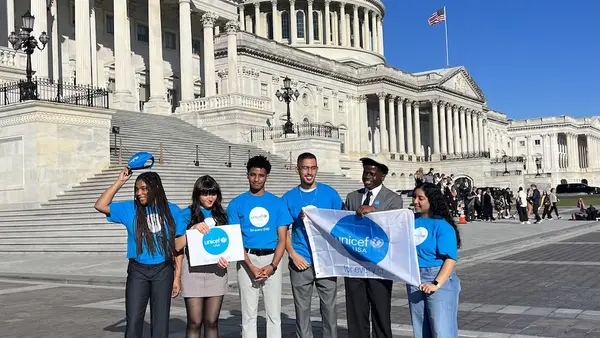
As we expand CCG nationally, we are also developing lighter-touch ways for more communities to engage. In the coming months, we will also share additional engagement opportunities, including focused learning cohorts for cities interested in advancing specific child-centered governance strategies, along with new tools and resources to support each strategy. We are also equipping youth with skills and tools — including a Child Impact Statement Toolkit, made by young people, for young people — and creating opportunities for them to support child-centered governance as partners and advocates in their communities.
This work is designed to be flexible and collaborative. As more communities engage, we will continue learning alongside them — refining guidance and strengthening the connection between research and practice.
Call to action: Join the National Learning Community Network
We invite city leaders, partners and advocates to download and review UNICEF USA's Child-Centered Governance briefs and explore how these strategies could support your community.
To stay connected, join UNICEF USA’s National Learning Community. The Community is the entry point for learning more, participating in virtual convenings and being the first to hear about tools and engagement opportunities in the U.S. and with global partner communities over the next year.
Centering children is not a single initiative — it is a shift in how decisions are made. When communities consider children’s rights, needs and perspectives, they build systems that are more equitable, coordinated and resilient. Our vision is a future where child-centered governance is not the exception, but the norm — one where every child’s voice has a place in shaping the policies that affect them and where children and their well-being are prioritized in decision-making.
HOW TO HELP
There are many ways to make a difference
War, famine, poverty, natural disasters — threats to the world's children keep coming. But UNICEF won't stop working to keep children healthy and safe.
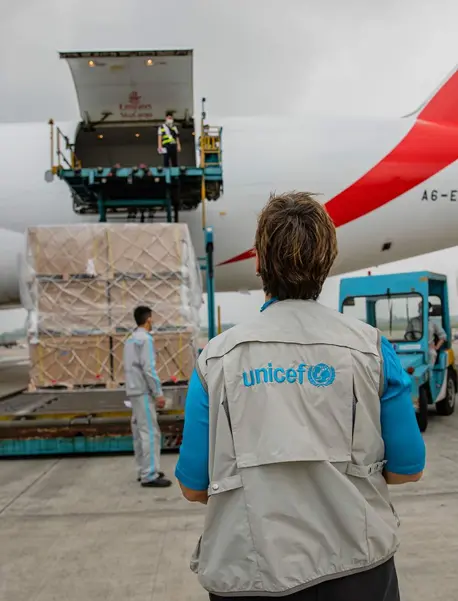
UNICEF works in over 190 countries and territories — more places than any other children's organization. UNICEF has the world's largest humanitarian warehouse and, when disaster strikes, can get supplies almost anywhere within 72 hours. Constantly innovating, always advocating for a better world for children, UNICEF works to ensure that every child can grow up healthy, educated, protected and respected.
Would you like to help give all children the opportunity to reach their full potential? There are many ways to get involved.