2026 Tax Rules and Tips for Easier, Cost-Effective Charitable-Giving Strategies
At a time when so many people need help, there are plenty of benefits — tax and philanthropic — to giving back through charitable donations.
You might not be thinking about your 2026 taxes — yet. But now is the time to take stock if you plan to deduct donations on your tax return come the new year.
Do you make spontaneous charitable contributions throughout the year? Or do you focus your year-end charitable giving around matching opportunities? Do you set fixed multi-year charitable donation goals?
No matter how you choose to give, there are many worthy causes and people needing support. With some careful planning, you can maximize the impact of your charitable giving for others and yourself.
Why give to UNICEF USA?
Deciding which charities to support is the first step, and it's no easy task. But if you care about making a better world for children, the choice is simple.
For over eight decades, UNICEF's global reach and holistic approach have helped save and improve more children's lives than any other humanitarian organization. UNICEF addresses the root causes of the issues children face through time-tested, innovative strategies to strengthen the systems they rely on. UNICEF delivers vital services, including health care, education, water and sanitation, nutrition and much more.
When you make a charitable donation to UNICEF USA, the U.S. 501(c)(3) that supports UNICEF’s programs, you help make a lasting difference for children in over 190 countries around the world. With an expert's advice and some careful planning, your support for children goes further.
Where to find tax information for charitable giving
Charitable contributions may be deductible if specific requirements are met — annual standard deduction and charitable-contribution limits among them. Equally important: ensuring that the charity you wish to support appears in the IRS' tax exempt organization search tool. You will find UNICEF USA on that list, along with other qualified organizations.
The IRS also offers an interactive tax assistant (ITA) that answers common questions about rules governing charitable contributions. The ITA is helpful as a starting point for understanding basic tax rules and requirements.
However, complex situations still require consultation with a tax professional or direct contact with the IRS. A financial advisor can also develop a tax-efficient strategy to maximize your charitable donations and impact.
Charitable-giving strategies for 2026
Of course, effective giving goes beyond knowing the rules. With guidance from an accountant and financial advisor, you may be able to optimize your charitable impact and tax benefits with these charitable-giving strategies:
- Consider bunching your charitable donations
- Explore donor-advised funds (DAFs)
- Donate stocks and bonds
- Tap your IRA
- Evaluate the overall impact of your support
- Seek professional advice
UNICEF USA's planned giving team can also provide assistance if you wish to explore making UNICEF USA part of your estate planning strategy.
Contact UNICEF USA planned giving by filling out this form, calling (866) 486-4233 or sending an email to LegacyGifts@unicefusa.org
For long-term planning, UNICEF USA offers a downloadable estate planning toolkit for:
- Setting family goals and creating a plan
- Lessening tax burdens
- Using trusts to support you, your family and loved ones
- Keeping a digital record of important information with everything organized in one place
- Easily updating records
How donor-advised funds work
DAFs are a flexible and tax-efficient way to make donations to IRS-qualified 501(c)(3) nonprofit organizations. Think of a DAF as an investment account dedicated to charitable giving. You can contribute cash, stocks, bonds and other appreciated assets. Contributions may qualify for a charitable-donation tax deduction in the year they’re made, but you can choose to distribute those donations over several years.
The sponsoring organization, which handles the investment and distribution details, simplifies the process for donors. Another benefit of DAFs: your charitable contributions, which are invested, may grow tax-free.
Many financial institutions, including Fidelity, Schwab and Vanguard offer DAFs. Donors who already have DAF accounts with Fidelity Charitable, Schwab Charitable, Vanguard Charitable, or another sponsor can recommend a grant directly from UNICEF USA's donor-advised fund page. Fees and minimums vary by institution, so clarify these upfront.
Learn more about supporting UNICEF USA via a donor-advised fund.
Support children through charitable giving
Giving to UNICEF USA is a powerful way to make lasting change for children, and many donors say it’s also personally rewarding. In the 2025 Bank of America Study of Philanthropy, those surveyed told researchers that they find it fulfilling.
Giving can also be something families do together. If you have children, talking with them about why you give is a good way to share your values.
Every day, UNICEF works hard around the world to help protect and uplift children. By making a charitable donation to UNICEF USA, you can be there every step of the way and help, too.
Help UNICEF create a more equitable world for every child. Please donate today.
Frequently asked questions about charitable giving in 2026
What are some charitable giving strategies for 2026?
Donors approach charitable giving in many ways, and the strategies that work for one person may not suit another. Some of the options donors may explore include:
- Bunching charitable donations — combining several years of giving into a single year, rather than spreading it out evenly
- Donor-advised funds (DAFs) — a giving account that allows donors to contribute now and recommend grants to charities like UNICEF USA over time
- Gifts of stocks and bonds — donating appreciated securities instead of cash
- IRA giving — supporting charitable causes through an IRA
Some donors also find it helpful to think about the overall impact of their giving, such as which causes matter most to them and how their gifts add up over time. UNICEF USA does not provide tax, legal or financial advice. Donors may wish to talk with an accountant or financial advisor about which strategies, if any, fit their circumstances. Those interested in including UNICEF USA in their estate plans can contact our planned giving team.
What should I know about charitable donation deductions in 2026?
Charitable contributions may be deductible when applicable requirements are met. Because individual situations vary, deductibility depends on a donor’s own circumstances. UNICEF USA’s Charitable Donation Tax Deductions page provides general information about the 2026 donation tax deduction, and the IRS offers resources on the rules for charitable contributions. Donors with questions about their own situation can contact a tax professional or the IRS directly.
How can I plan my year-end charitable giving?
Many donors plan their year-end charitable giving ahead of time. Planning can involve thinking about when and how to give. Some donors time their gifts around year-end matching opportunities, which may help increase the impact of a donation. Others choose charitable giving strategies that align with their goals, such as a donor-advised fund, a gift of stocks or bonds, or a gift from an IRA. Planning early may leave more time to compare options and talk with advisors. Visit UNICEF USA’s end-of-year giving page and donation FAQs to learn more.
The story doesn't end here. Help change what happens next.
HOW TO HELP
There are many ways to make a difference
War, famine, poverty, natural disasters — threats to the world's children keep coming. But UNICEF won't stop working to keep children healthy and safe.
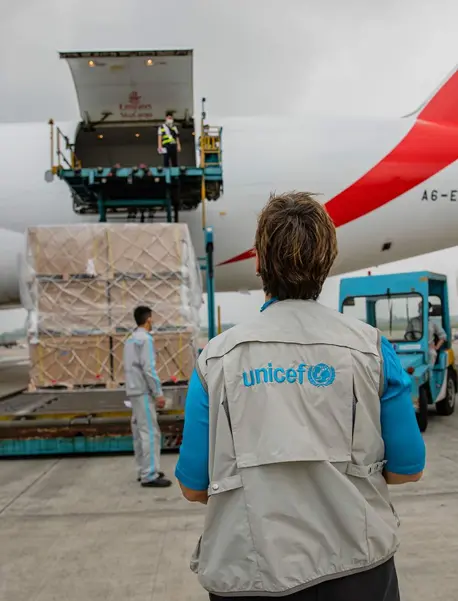
UNICEF works in over 190 countries and territories — more places than any other children's organization. UNICEF has the world's largest humanitarian warehouse and, when disaster strikes, can get supplies almost anywhere within 72 hours. Constantly innovating, always advocating for a better world for children, UNICEF works to ensure that every child can grow up healthy, educated, protected and respected.
Would you like to help give all children the opportunity to reach their full potential? There are many ways to get involved.