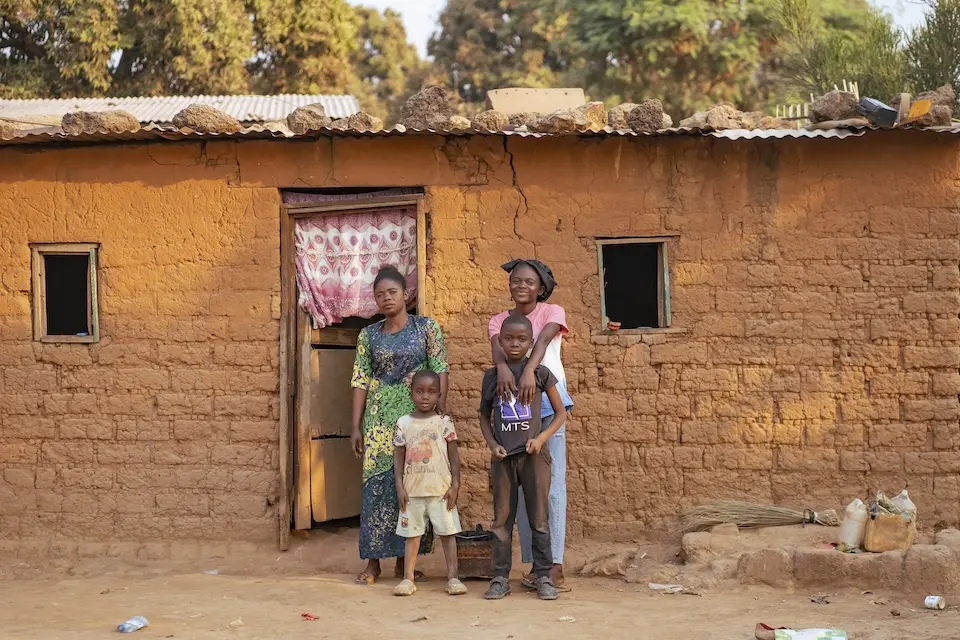
State of the World's Children 2025: Child Poverty
UNICEF's latest flagship State of the World's Children (SOWC) report examines child poverty and calls for greater investments in the systems and solutions that allow impoverished children to survive and thrive.
UNICEF reports over 417 million children severely deprived of at least two essential services they need daily
In The State of the World’s Children 2025: Ending Child Poverty – Our Shared Imperative, released Nov. 20, 2025, World Children's Day, UNICEF reports that 1 in 5 children in low- and middle-income countries are severely deprived in at least two areas crucial for their health, development and well-being.
Drawing from data from over 130 low- and middle-income countries, the report measures deprivations across six categories: education, health, housing, nutrition, sanitation and water.
Countries that make child poverty a national priority have seen progress toward reducing it, the report notes — but this progress is fragile, and prone to reversals due to climate change, conflict, economic instability and declining official development assistance — all crises that pose a serious and immediate threat to children’s present lives and future opportunities.
Key takeaways:
-
globally, more than 19 percent of children live in extreme monetary poverty, surviving on less than $3 per day; nearly 90 percent of these children are in sub-Saharan Africa and South Asia
-
an estimated 900 million children globally face multidimensional poverty, meaning they lack access to at least one basic need; more than 417 million children globally are deprived of at least two; 118 million children experience three or more deprivations and 17 million face four or more
-
lack of sanitation was found to be the most common form of deprivation, with 65 percent of children lacking access to a toilet in low-income countries; a lack of adequate sanitation can increase children’s exposure to disease
-
the share of children facing one or more severe deprivations in low-and-middle-income countries dropped from 51 percent in 2013 to 41 percent in 2023, largely due to prioritizing child rights in national policies and economic planning; however, progress is stalling
-
conflict, environmental crises, demographic shifts, mounting national debt and widening technological divides are compounding the problem of child poverty worldwide
-
unprecedented cuts to Official Development Assistance (ODA) risk deepening child deprivation across low- and middle-income countries
-
poverty undermines children’s health, development and learning, leading to weaker job prospects, shorter lifespans and increased rates of depression and anxiety; the youngest children, those with disabilities and those living in crises are particularly vulnerable
-
an analysis of data from 37 high-income countries showed that 50 million children — or 23 percent of the child population in these countries — live in relative monetary poverty, meaning their household has significantly less income than most others in their country, potentially limiting their ability to participate fully in everyday life
Progress toward ending child poverty is possible
It is not all bad news. The report cites some encouraging developments in specific countries as evidence that progress toward ending child poverty remains possible.
For instance, Tanzania achieved a 46-percentage-point reduction in multidimensional child poverty between 2000 and 2023, partially driven by government cash support grants and empowering poor households to make their own financial decisions.
In Bangladesh, child poverty dropped by 32 percentage points over the same period, thanks to government-led initiatives that increased education and electricity access and improved housing quality, and investments in water and sanitation services that eliminated open defecation.
The report argues that ending child poverty is within reach, because proven solutions exist. The report advocates for centering child rights in all government strategies, policies and actions aimed at poverty reduction by:
- making ending child poverty a national priority, embedded into laws and plans
- integrating children’s needs into economic policies and budgets
- providing social protection programs, such as cash support for families
- expanding access to essential public services, such as education, health care, water, sanitation, nutrition and housing
- promoting decent work for parents and caregivers to strengthen their economic security, which is so closely linked to children’s well-being
Related: Ending Child Poverty: Solutions that Work
A call to action
The release of UNICEF's 2025 SOWC report comes at a time when many governments around the world are scaling back foreign assistance. Cuts in development aid could result in the deaths of 4.5 million children under the age of 5 by 2030, according to The Lancet. At the same time, recent UNICEF estimates show the cuts could leave 6 million more children out of school by next year.
“Too many children were already deprived of their basic needs, even before the global funding crisis threatened to make things far worse,” UNICEF Executive Director Catherine Russell said. “This is not the time to retreat. It’s a time to build on the hard-earned progress for children that has been made over the years.
Investing in children delivers on a healthier and more peaceful world — for everyone. — Catherine Russell, UNICEF Executive Director
"Governments and businesses can do that by strengthening investment in key services for children to keep them healthy and protected and ensuring that they have access to essentials like good nutrition, especially in fragile and humanitarian contexts," Russell added. "Investing in children delivers on a healthier and more peaceful world — for everyone.”
National action and ownership is essential but not enough, however. UNICEF also calls on the international community to commit to coordinated global action to address challenges such as the debt crisis, development aid cuts and climate change.