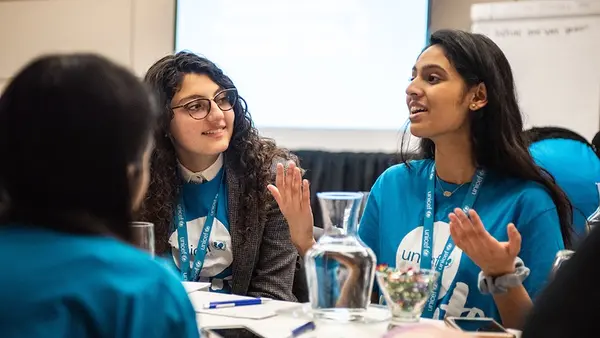
Building Communities For Every Child Through the Child Friendly Cities Initiative
With guidance from UNICEF USA, communities in the United States are adopting child-centered local governance strategies and prioritizing the rights, voices and best interests of children and youth.
How We Work | Become a Child Friendly City | CFCI FAQs | CFCI in the News
When we make our communities better places for children, we make them better places for all
The UNICEF Child Friendly Cities Initiative (CFCI) brings UNICEF together with local stakeholders to establish safer, more just, equitable, inclusive and child-centered cities and communities.
CFCI uses the UN Convention on the Rights of the Child as a framework to help local governments prioritize the needs of children and young people, combat discrimination and elevate youth voices in local governance and decision making. Through child-centered governance strategies — like youth councils, children’s cabinets and child impact statements — CFCI helps cities systematically embed the voices, rights and best interests of children into policies, budgets and decision-making.
Through this flexible, dynamic, child rights-focused framework, neighborhoods become safer, schools and health systems function better, infrastructure is strengthened and communities are improved for all citizens.
The initiative launched globally in 1996 to protect children’s rights in an increasingly urbanized and decentralized world. Since its inception, CFCI has been adopted in over 3,500 municipalities in more than 40 countries.
On Aug. 12, 2020, International Youth Day, UNICEF USA launched the Child Friendly Cities Initiative in the United States. Boulder, Colorado; Decatur, Georgia; Houston, Texas; Minneapolis, Minnesota; Prince George's County, Maryland and Alton, Illinois represent the first cohort to partner with UNICEF USA to implement an ambitious, multi-year process toward recognition as a UNICEF Child Friendly City or County. Following the five-year anniversary of UNICEF USA launching the CFCI pilot in the United States, Denver, Colorado, Salem Massachusetts and El Paso, Texas represent the first post-pilot cohort. In support of UNICEF USA’s vision to develop "Communities for Every Child," municipal governments collaborate across sectors and with children, youth and families to ensure that the best interests and voices of children are central to local governance decisions.
On Aug. 12, 2023, the three-year anniversary of the pilot launch, following successful implementation of their CFCI Local Action Plan and independent evaluation, the City of Houston became the first officially recognized UNICEF Child Friendly City in the United States. On Feb. 14, 2024, the City of Minneapolis joined Houston as the second city to receive recognition a a UNICEF Child Friendly City. On March 21, 2025, Decatur was recognized as the United States' third UNICEF Child Friendly City.
A Child Friendly City takes actions to improve child well-being — while also creating pathways for their voices to be heard
Following completion of a readiness assessment in consultation with UNICEF USA and a formal partnership agreement between the local government and UNICEF USA, to gain recognition as a UNICEF Child Friendly City or County, government officials and community leaders — including children and youth — engage stakeholders and conduct a situation analysis of child well-being in their respective city or county. Based on the findings, and with guidance from UNICEF USA, the communities set out to implement a Local Action Plan that prioritizes the best interests of children and youth within their local policies, programs and services. Upon a successful independent evaluation, communities will receive recognition for a period of time with the option to renew over multiple CFCI cycles to deepen, expand and sustain results for children.
Is your community child-friendly?
To find out, just ask the kids who live there.
Do they feel safe? Can they go to a doctor when they are sick? Do they like their school?
Are there plenty of parks and playgrounds where they can go and meet up with friends?
Do people listen to them when they talk — their teachers, parents, coaches? Do they feel — most of the time — like they get their fair share?
UNICEF USA wants to ensure that every child who lives in your community can answer a resounding "Yes!" to all the above. For more information, resources and case studies about the global UNICEF Child Friendly Cities Initiative visit childfriendlycities.org. If you would like to learn more about UNICEF USA's Child Friendly Cities Initiative, check out our CFCI Brochure.
Join our Community Alliance for Child Rights: Bridging Research and Policy LinkedIn Group. This space is designed to foster collaboration, share impactful research and connect our community of municipal partners and researchers.
Explore the Communities for Every Child Calendar: Our 2025–2026 calendar is a tool for local leaders, city departments, community organizations, youth groups and partners to come together around key moments — like World Children’s Day — to center children and youth in decision-making and inspire collective action. From workshops and trainings to celebrations, forums and partner spotlights, the calendar highlights opportunities to engage and learn throughout the year.
To ensure that we can provide the highest level of support and deliver impactful results, UNICEF USA considers new CFCI municipal partnerships selectively based on factors including community readiness, organizational capacity and alignment with UNICEF USA’s strategic goals. Should you be interested in having an exploratory conversation about the potential of a CFCI partnership with UNICEF USA in your community, please email cfci@unicefusa.org.
Watch the UNICEF USA Child Friendly Cities Initiative in action
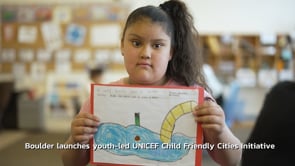
Children and young people in Boulder, Colorado share what they want their city to look like as they launch their youth-led Child Friendly Cities Initiative: