
World Football Day: How Soccer Connects Children Worldwide
Soccer — known as football in most of the world — is more than a sport. It is played in countries around the globe, recognized by children everywhere and widely considered the most popular game. What's great about soccer for kids is that all it takes is a ball, a patch of ground and someone to play with. No equipment, no common language, no court required.
That simplicity is what makes soccer a vehicle for immediate connection and camaraderie. It’s also why soccer is one of UNICEF’s most effective tools for helping children and young people living in some of the world’s toughest places immerse themselves in the healing power of play.
World Football Day, observed every year on May 25, is an opportunity to celebrate that power. And few stories capture it better than Peter's.
When armed groups took over his home in Port-au-Prince, Haiti, Peter fled to Peredo in the Southeast, moving in with his aunt. There, he found a UNICEF child-friendly space — set up with U.S. government support — where he could be a kid again: taking part in group activities, spending time with other displaced children and doing something he had longed to do back home but couldn't: go outside and play soccer.
"Football is my pride. Even when I got injured, I never wanted to give up," Peter says. "When I play, I forget everything, and I dream of representing Haiti."
What is World Football Day and why does it matter?
The United Nations General Assembly named May 25 World Football Day in 2024 to commemorate the 100th anniversary of the first truly global football tournament held at the 1924 Paris Olympics. The resolution marking the date reaffirms sport as an enabler of sustainable development, and football in particular as a vehicle for global cooperation, solidarity and unity.
Football or soccer? It's all the same to kids
Soccer, known as football in most of the world, is one of the most-played, most-watched sports. And for children, especially, it creates a sense of belonging instantly, across barriers that might divide them.
UNICEF harnesses that power to help children and young people tap into their inner strength and innate joyfulness. From displacement camps in Sudan to schoolyards in Niger, soccer shows up again and again as a tool for connection, confidence and hope — a reminder that circumstances don’t define children and that something bigger is possible for each one.
The benefits of soccer for kids around the world
The benefits of soccer for kids go far beyond physical activity.
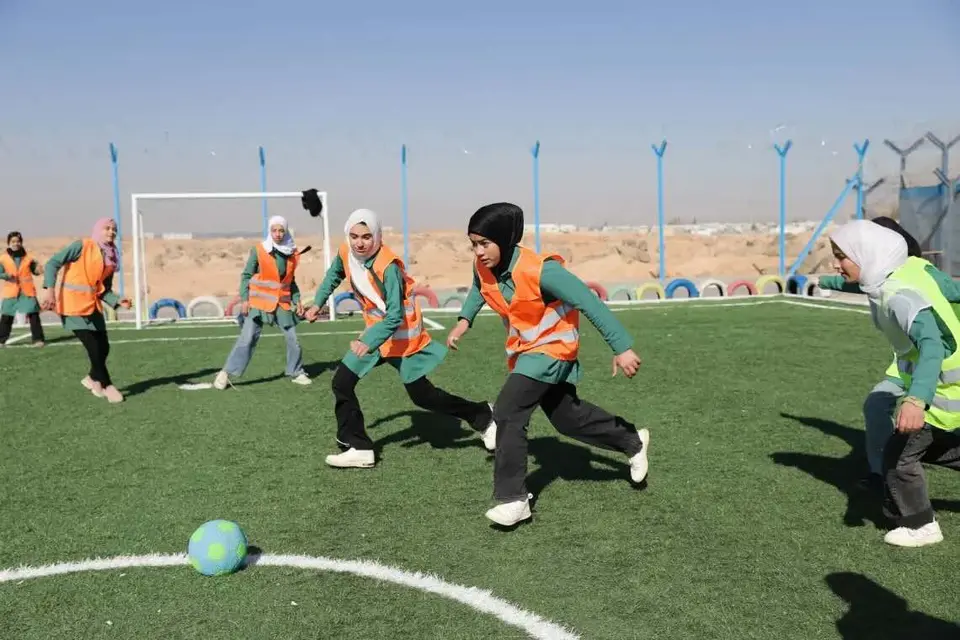
In Jordan, girls from Syria who have spent most of their lives in the Zaatari refugee camp are forging new identities on soccer fields installed on school grounds in 2025. Leen, the 13-year-old daughter of a former Syrian National Team football player, was a dedicated student, but she always felt something was missing. This new playing field changed that.
Girls and boys get equal playing time, ensuring girls have a fair chance to reap the benefits of playing soccer. "Before, we didn’t have a proper space for sports lessons," Leen says. "But now, we can play football, run and learn sports together. It’s made a big difference in how we feel about school."
How soccer supports child development
The science backs up what Peter, Mohammed and Leen already know: sport builds strong minds and healthy bodies.
Two studies conducted by the Barça Foundation and UNICEF's Office of Research in 2019 and 2021 analyzed evidence from more than 300 sport-for-development programs across 100 countries. This research, combined with 50 case studies, confirmed that sport is an effective tool for aiding child development, enhancing life skills and improving academic performance.
Soccer also nurtures leadership skills and builds self-esteem — particularly among adolescent girls, who gain opportunities for advancement in communities where gender-related barriers run deep.
Playing soccer also pays future dividends. Children who play are more likely to stay active as adults compared to kids who don’t grow up playing sports. And when inclusive athletics programming levels the playing field for children with disabilities, soccer can make a life-changing difference.
Learn more about how sport drives development — and sets kids up for success
How soccer helps children feel connected in challenging environments
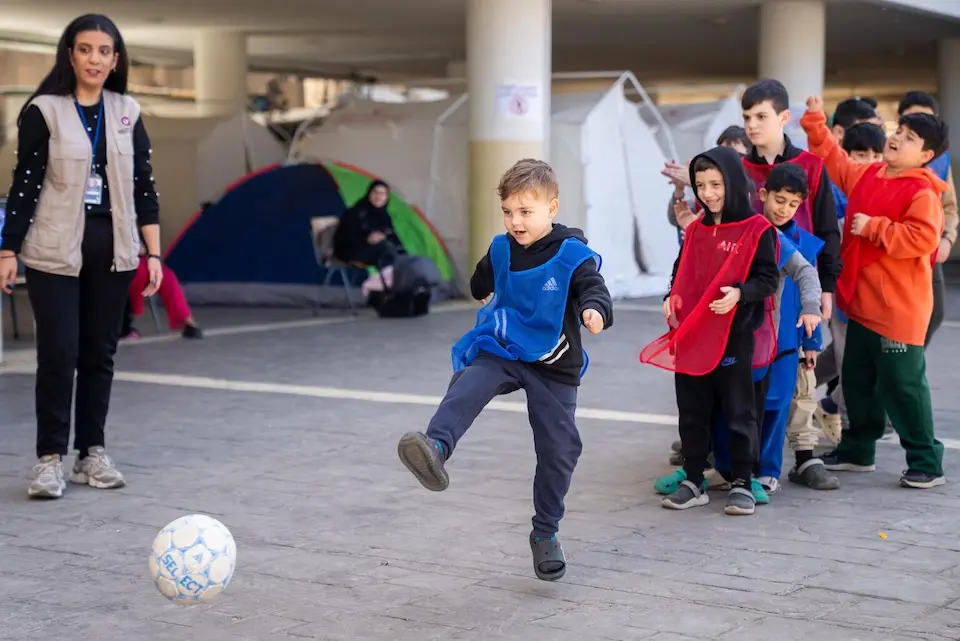
For children navigating conflict and displacement, soccer can offer something harder to measure than fitness or grades — a chance to get back to being a kid and a reason to keep going.
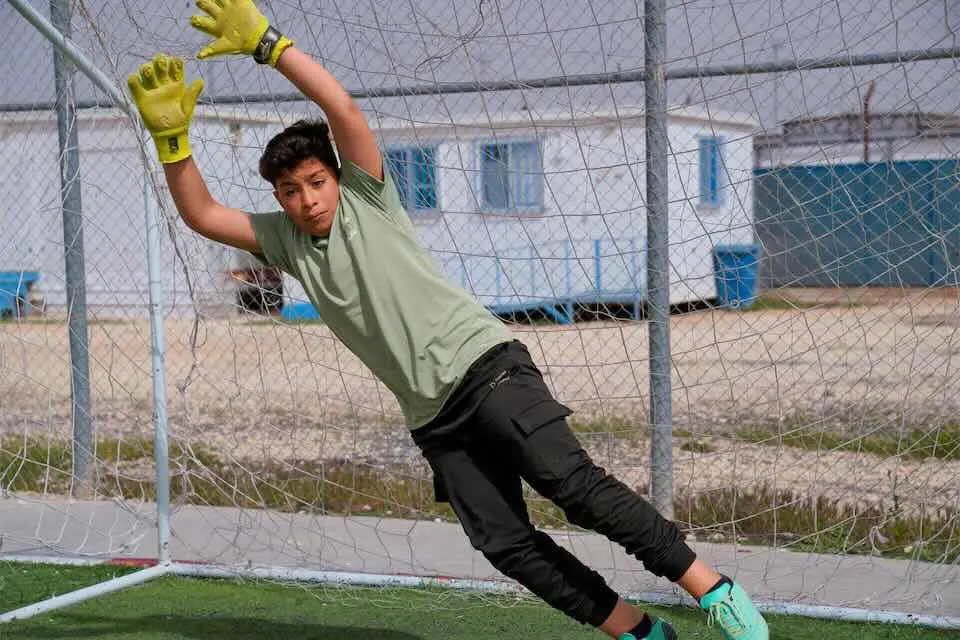
Separated from his family by civil war in Sudan, 13-year-old Mohammed finds solace playing football at the camp for displaced people Gedaref, Sudan. Mohammed learned to play back home in Gezira state, where he played soccer with his friends, developing the leadership skills he draws on to round up players and organize matches at the UNICEF-supported child-friendly space.
As he waits for the day he will see his family again, Mohammed immerses himself in the sport that brings him so much happiness.
“The thing I love most at the child-friendly space is soccer,” he says.
UNICEF and its partners create child-friendly spaces for kids like Mohammed who live amid conflict and crisis. Getting to feel safe, playing, learning and hanging out with friends offers a healing respite and a chance to hold onto dreams. Mohammed hopes to become a professional footballer and an architect who can help rebuild his country.
The link between soccer and future goals can be a lifeline for children and teens, whose surroundings can easily derail their plans, especially for girls growing up in countries where child marriage is common.
Pascaline lives in Lacouroussou, a poor neighborhood in Niamey, Niger’s capital. Niger has the highest rate of child marriage in the world, with over 70 percent of girls marrying before their 18th birthday. But with her soccer gear and schoolbooks always at the ready, Pascaline is determined to avoid that fate.
Pascaline attends Académie Atcha, a local soccer school that combines academics and athletics. By giving girls a chance to play sports in a safe, supportive environment, the school builds their confidence and helps them understand their rights.
"My students come to all my classes with their homework completed," says Garba, Pascaline's teacher. "It keeps them motivated to learn. School sports have added value for girls — they are the most vulnerable ones."
Learn more about how soccer is used to help end child marriage in Niger
How the FIFA World Cup brings the world together through soccer
The 2022 FIFA World Cup in Doha, Qatar, the first World Cup held in the Middle East, delivered records of all sorts, including personal bests for the stars of the Argentina vs. France finals.
As Argentina's captain, Lionel Messi led his team to their first World Cup victory, winning the Adidas Golden Ball Award along the way.
France’s forward, Kylian Mbappé, became only the second player to score a hat-trick in two back-to-back FIFA World Cup finals. Mbappé also scored the tournament’s most powerful scoring shot with his second-half 123.34km/h volley that tied the match.
Viewership numbers also reached historic peaks. For 29 days, football dominated the conversation, uniting fans and players from around the world: More than 3.4 million spectators attended matches. Over 1 million visitors traveled to Qatar to watch in person, with visitors from Saudi Arabia, India, the U.S., the United Kingdom and Mexico making up the largest contingents.
For fans like Leen, the best part about watching soccer is the enjoyment it brings, wherever you're watching.
"We love watching football together on TV, especially when Messi plays,” says Leen. “When he scores a goal, we all cheer with excitement as a family. These are some of my favorite memories."
Messi, who extended his contract with Inter Miami CF of MLS through 2028, has received a personal plea from FIFA President Gianni Infantino to play in this year’s World Cup. But even without him, the sport's universal appeal crosses borders, languages and cultures in a way few things can.
How global soccer moments support children beyond the game
Global events like the FIFA World Cup and World Football Day raise awareness of children’s rights and the essentials every child needs to thrive. Health care, education, food, protection, and safe water are must-haves. Play is just as critical.
The right to play is recognized under the Convention on the Rights of the Child. It is a central tenet of the Child Rights and Sports Alliance, which was launched in the run-up to FIFA World Cup 2026. In addition to expanding access to soccer and strengthening child safeguarding in sports, the Child Rights and Sports Alliance seeks to direct some of the global attention the World Cup receives toward elevating the rights and voices of vulnerable children.
FIFA World Cup 2026 has incorporated human rights considerations into its bid process, execution and legacy — a significant step for a tournament of its scale. This Alliance also aims to help cities fulfill the human rights and legacy components focused on children. Together, Alliance members are working to center children's voices, expand soccer access as a development tool and strengthen child safeguarding in sport.
UNICEF works in more than 190 countries to achieve those goals and provide the broader foundation every child needs to thrive. When times are tough, soccer helps children and teens look beyond their current circumstances and challenges to a future filled with possibility.
Leen would love to play for a women’s professional football team one day, but it’s okay if that dream doesn’t pan out:
"Even if I don’t make it to a big team, I’ll continue playing football because that’s what makes me happy," she says.
Frequently asked questions about World Football Day and soccer for kids
When is World Football Day?
World Football Day is observed every year on May 25, the anniversary of the 1924 Olympic football tournament in Paris — the sport’s first truly global international competition. It was established by the United Nations General Assembly in 2024 as a moment to celebrate the power of football and soccer to bring people together across cultures and communities.
Why is soccer important for kids around the world?
Soccer supports children’s physical, emotional and social development. It builds confidence, teaches teamwork and resilience and gives children a universal way to connect across language, culture and background. Research across more than 300 sport-for-development programs in 100 countries shows that soccer and other sports can improve academic performance and help children and young people build the skills required to seek a better life, particularly for the most vulnerable children. For girls, participation in sport has been shown to increase self-esteem and open up opportunities in communities where gender barriers run deep.
Is soccer the most popular sport in the world?
Football — called soccer in the U.S. — is widely considered the world’s most popular sport for the number of people who play it and watch the game. Its global reach comes largely from its simplicity: a net helps, but in places where children don’t have one, a ball and an open space are all that’s needed.
How old should kids be to start soccer?
Young children can begin enjoying the benefits of playing soccer with simple kicking and passing activities as soon as they can run and follow basic directions. The American Academy of Pediatrics notes that most children are ready for organized play around age 6, emphasizing fun and learning over competition. Once learned, soccer is a game that can be played and enjoyed at every age.
How can soccer and global events support children beyond the game?
Soccer creates connection, but lasting change requires more. Global events like World Football Day and the FIFA World Cup 2026 generate attention that can be directed toward children’s rights and needs — from child safeguarding in sport to access to education, health care and safe environments. Initiatives like the Child Rights and Sports Alliance, launched ahead of FIFA World Cup 2026, are working to ensure that the reach of the world’s most popular sport translates into real protections and opportunities for children worldwide.
Highlights
- Observed every May 25, World Football Day was established by the UN in 2024 to mark the 100th anniversary of the first global football tournament at the 1924 Paris Olympics.
- Football, requiring minimal equipment and no common language, easily brings children together across cultures and circumstances.
- UNICEF leverages football to provide normalcy, healing and hope to children in crisis.
- Research shows soccer improves academic performance, builds life skills and is especially empowering for girls.
- Major tournaments like the FIFA World Cup unite billions globally and, through initiatives like the Child Rights and Sports Alliance, are used to advance children's rights.
- UNICEF supports every child's right to play, which is enshrined in the UN Convention on the Rights of the Child.
World Football Day is observed every year on May 25, the anniversary of the 1924 Olympic football tournament in Paris — the sport’s first truly global international competition. It was established by the United Nations General Assembly in 2024 as a moment to celebrate the power of football and soccer to bring people together across cultures and communities.
Soccer supports children’s physical, emotional and social development. It builds confidence, teaches teamwork and resilience and gives children a universal way to connect across language, culture and background. Research across more than 300 sport-for-development programs in 100 countries shows that soccer and other sports can improve academic performance and help children and young people build the skills required to seek a better life, particularly for the most vulnerable children. For girls, participation in sport has been shown to increase self-esteem and open up opportunities in communities where gender barriers run deep.
Football — called soccer in the U.S. — is widely considered the world’s most popular sport for the number of people who play it and watch the game. Its global reach comes largely from its simplicity: a net helps, but in places where children don’t have one, a ball and an open space are all that’s needed.