
Support Children in Syria — Donate to UNICEF
Millions of children and families in Syria continue to face dire conditions amid ongoing instability and a slow recovery following 14 years of civil conflict. UNICEF is there.
Meeting urgent humanitarian needs, paving the road to recovery in Syria
Syria’s remains one of the world’s most complex humanitarian crises. After over a decade of conflict, natural disasters and economic hardship, 6.5 million children in Syria remain in need of humanitarian assistance. Over 2 million children are at risk of malnutrition — including 600,000 at risk of severe wasting, which can be fatal if left untreated.
With 260 in country staff stationed across six field offices and a main office in Damascus, UNICEF remains on the ground inside Syria, working with partners to deliver emergency support and protection while also scaling essential social services and helping to rebuild and strengthen systems to withstand future shocks.
UNICEF’s “One Syria” strategy is focused on system recovery and reform. Programs support education, health, nutrition, water, sanitation and hygiene, social policy, climate resilience and youth empowerment, in addition to social behavior change, and are aligned with the UN Sustainable Development Goals.
UNICEF is also helping Syria manage a rapid influx of refugees returning from Lebanon triggered by a regional military escalation.
Learn more: UNICEF in the Middle East
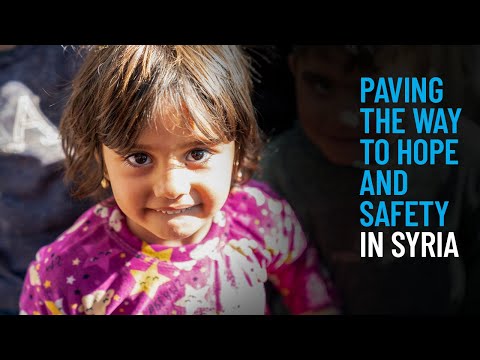
Video: UNICEF stands committed to helping restore essential services, protect children as Syria enters new chapter
Earthquakes, economic ruin: Syria's overlapping crises
Syria is still grappling with the aftermath of powerful earthquakes that struck both Syria and Türkiye in February 2023, displacing millions of people.
A collapsing health care system, lack of access to safe water, poor sanitation and increasing food insecurity have heightened risks of fast-spreading waterborne and vaccine-preventable diseases, while also driving increases in malnutrition rates among children.
There are still millions of Syrian children living as refugees in Egypt, Iraq, Jordan, Lebanon and Türkiye. Those who have returned face multiple hardships.
The tattered economy has left families struggling to afford food and other basics, while contributing to the normalization of gender-based violence and child exploitation. Around 90 percent of families in Syria live in poverty — many of them resorting to negative coping mechanisms.
An entire generation of children has missed out on at least some education. Nearly half of the 5.5 million school-aged children — some 2.4 million children aged 5 to 17 — are out of school, with more than 1 million at risk of dropping out, further heightening protection risks.
The country remains in a period of political and socio-economic uncertainty following the December 2024 collapse of the Syrian government led by Bashar al-Assad.
Some 6.2 million people remain internally displaced, with 1.4 million living in camps. The continued economic crisis has resulted in a poverty rate of over 90 percent. An estimated 16 million people, including 6.5 million children, are in need of humanitarian assistance.
UNICEF remains on the ground inside the country, collaborating with humanitarian, civil society and other partners to bring stability and address deprivations that remain prevalent across the country. Protection risks for children also remain high.
With the lifting of sanctions and growing humanitarian access signaling new opportunities, UNICEF has shifted toward national recovery, and remains steadfast in its commitment to deliver critical support — and to bring hope for the future.
"Children in Syria deserve a future worthy of their strength" — statement by UNICEF Goodwill Ambassador Muzoon Almellehan
How UNICEF is helping children in Syria
A significant proportion of the population of Syria remains in need of humanitarian assistance. UNICEF is there, delivering support and protection.
Priorities include:

- improving access to safe drinking water and sanitation services, distribute hygiene kits and promote safe hygiene practices
- reaching millions of children with essential nutrition services, while strengthening malnutrition prevention
- vaccinating children against measles, polio and other preventable diseases, including those living in hard-to-reach areas through mobile teams, while also strengthening infection prevention and control at the community level
- helping out-of-school children get back to learning and to catch up on their education
- providing mental health and psychosocial support activities to hundreds of thousands of children and caregivers in need
- strengthening violence prevention and response, teaching children about unexploded ordnance and how to stay safe
- expanding social protection for the poorest families through humanitarian cash transfers
- expanding life-skills programs, vocational education and entrepreneurship training for adolescents and young people
Continued support from the international community is critical for restoring systems that deliver essential basic social services, like education, water and sanitation, health, nutrition, child and social protection, ensuring that no child in Syria is left behind.
UNICEF works in over 190 countries and territories to create a more equitable world for children.