CHILDREN'S
EDUCATION
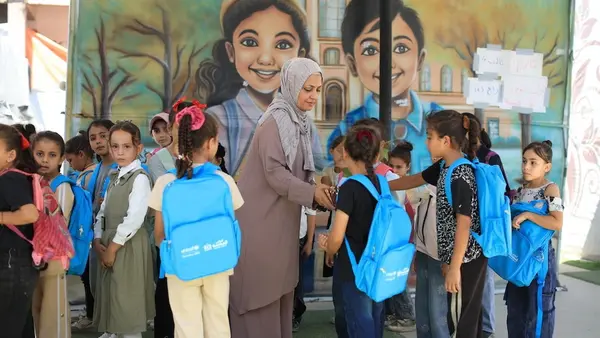
UNICEF supports every child’s right to an education no matter where they must learn — under a tent in a refugee camp, at a local school or at home using a parent’s mobile phone. Through innovation and partnership, UNICEF education programs help expand learning opportunities and build more hopeful futures for children around the world.
Education transforms lives and breaks the cycle of poverty
For far too many children around the world, access to education — a fundamental right — is only a dream. Many children in low- and middle-income countries leave primary school unable to read and understand a simple story. Only half of refugee children have attended primary school, and less than a quarter have attended secondary school.
When a child can't go to school...
- They face greater risks of lifelong poverty.
- Their health may suffer: In many parts of the world, school is where children get health care, immunizations and their one nutritious meal of the day.
- They face higher risks of abuse; if a child is living in a home where they are already experiencing neglect or dysfunctional parenting, being out of school means they are cut off from supportive teachers and friends.
The importance of educating girls
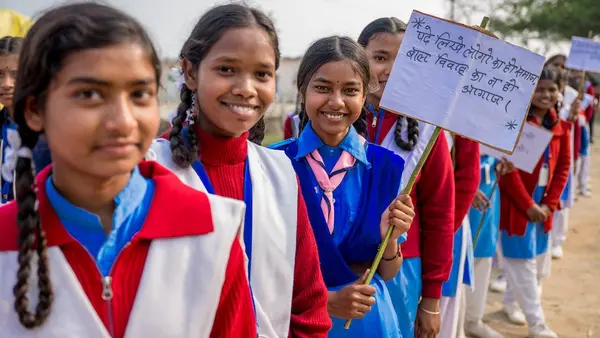
Girls are particularly at risk of missing out on their right to an education, and when they do, it's a loss for them, their family, the economy and all of society. Educating girls bolsters community stability and resilience. Girls who complete a secondary school education earn more, marry later and raise children who are healthier and better nourished. Educated girls are better protected from discrimination, exploitation and abuse, and help drive economic growth, creating more opportunities for all.
Girls from impoverished communities and girls displaced by conflict or climate-related disasters face higher risks of teen pregnancy, child labor and child marriage when access to education is disrupted and families are struggling to cope.
How UNICEF helps kids learn
UNICEF's education programs take many forms. Whether it's setting up temporary classrooms for child refugees, distributing books and other learning materials, training teachers or rebuilding an entire educational system, UNICEF works with local, national and global partners to improve children's access to quality education, including early learning.
Protecting Children's Education in Emergencies
Early Childhood Development
The first few years of life are crucial to every child’s development. Together with partners, UNICEF works around the world to establish the foundations for children to grow, learn and thrive, by supporting early childhood education programs and counseling parents and caregivers.
Early Childhood Development (ECD) support also serves as a form of psychosocial support for children in crisis situations, which is why UNICEF rushes ECD kits when responding to emergencies.
Learn more about UNICEF-supported Early Childhood Development programs
Learning Passport
UNICEF and partners continue to build on the investments made during the COVID-19 pandemic to provide access to education to out-of-school children through the Learning Passport, an innovative digital platform. The project is expanding beyond remote learning to create more equitable, higher-quality learning opportunities for all students.
The platform is highly flexible, and with its supporting ecosystem, it can be adapted to meet the specific needs of learners and educators in different countries and contexts. From foundational learning to skills development, the Learning Passport covers the full range of educational content and can function in formal and informal education settings, with and without internet connectivity.
Learn more about Learning Passport
The Kids in Need of Desks (K.I.N.D.) Fund
In Malawi, more than 50 percent of students must learn sitting on the ground or floor because they go to a school without chairs and desks. In 2010, UNICEF USA and MSNBC's Lawrence O'Donnell set out to change that with the Kids in Need of Desks (K.I.N.D.) Fund, an initiative to provide Malawi's students with the comfort and dignity they need to do their best work.
Since then, 405,000 desks have been delivered, benefiting more than 1.6 million learners. The initiative has also provided scholarships to Malawian girls to give them the foundation they need to go on to higher education.
Learn more about the Kids in Need of Desks (K.I.N.D.) Fund
Let Us Learn — Education Equity
Access to quality and equitable education is every child's right, regardless of their gender, background, location, income or circumstance. Yet, today far too many things stand in the way of children exercising that right: conflict, natural disasters, health crises, poverty, geographic isolation, social exclusion. The UNICEF Let Us Learn program, which launched in 2011 in Afghanistan, Bangladesh, Liberia, Madagascar and Nepal, seeks to level the playing field and remove the obstacles to out-of-school children's learning.
Through Let Us Learn, UNICEF and partners provide out-of-school children with alternative ways to learn while also helping to strengthen formal education systems for fully enrolled students, paying particular attention to girls and children with disabilities. The education equality initiative supports children into young adulthood through early childhood education, primary and secondary school, as well as vocational training.
Learn more about UNICEF Let Us Learn
Skilling Youth
Through initiatives such as UPSHIFT and Skills4Girls, UNICEF provides skills building and vocational training opportunities that open doors to employment and give young people hope for the future. Programs cover life skills, also known as transferable skills, digital skills, green skills and more.
Learn more about how UNICEF is skilling youth alongside partners around the world
Frequently asked questions about children's education
What educational programs for kids does UNICEF support?
UNICEF supports early childhood education, temporary classrooms and learning supplies during emergencies, teacher training and education system rebuilding. Programs include the digital Learning Passport, the K.I.N.D. Fund for desks and girls’ scholarships in Malawi, Let Us Learn for equitable education access and youth skills initiatives such as UPSHIFT and Skills4Girls. Visit Every Child Educated for an overview of UNICEF’s global children’s education work.
How can I donate for child education?
You can donate to UNICEF to help provide children with learning materials, trained teachers, safe learning spaces, digital education, school furniture, scholarships and vocational training. You can also support a specific initiative, such as the K.I.N.D. Fund.